Computer Graphics

Rasterization in Detail

Prof. Dr. David Bommes
Computer Graphics Group

Last Time: 3D Transformations and Projections

Rotation around x/y/z axes

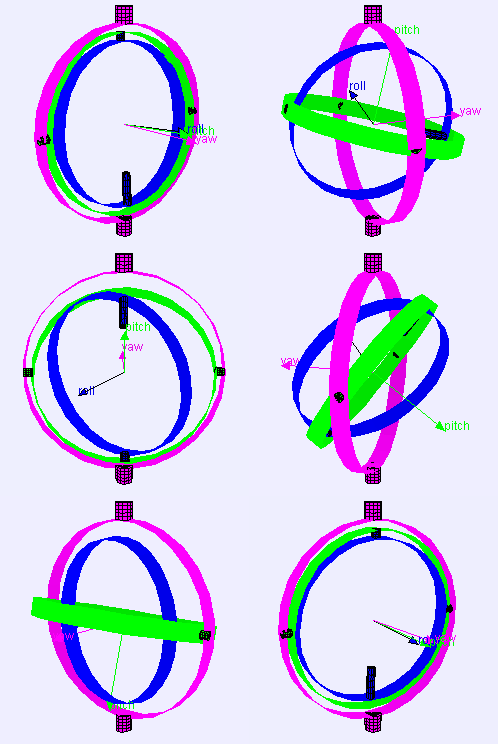
  • Can we compose any 3D rotation from \(\mat{R}_x\), \(\mat{R}_y\), \(\mat{R}_z\)? \[ \mat{R}\of{\alpha, \beta, \gamma} \;\stackrel{?}{=}\; \mat{R}_x\of{\alpha} \cdot \mat{R}_y\of{\beta} \cdot \mat{R}_z\of{\gamma}\]
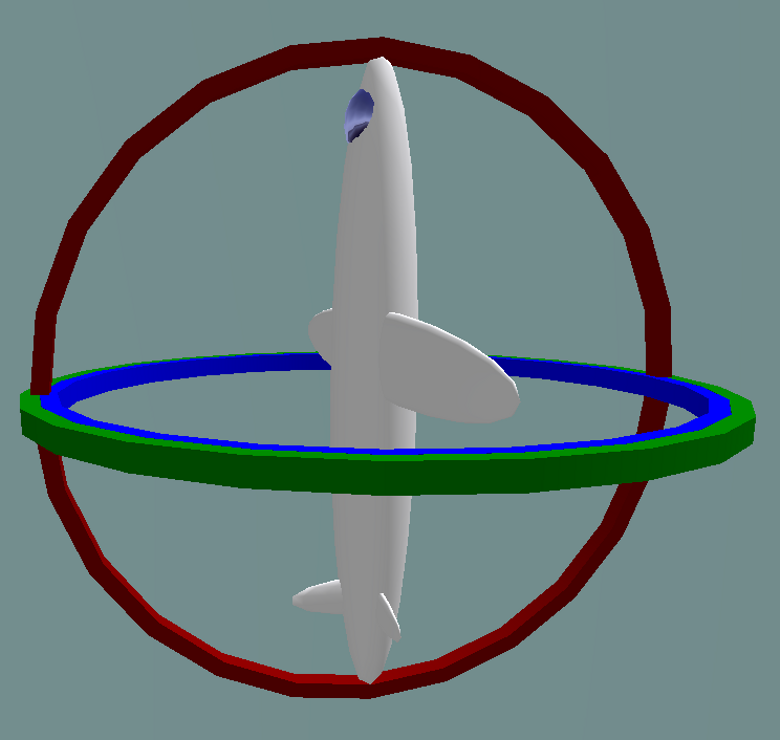
images/gimbal-3.gif
Euler angles

  • This representation is called Euler angles
    • Often used in flight simulators: roll, pitch, yaw
    • Problem: gimbal lock!
images/gimbal-2.png
Gimbal lock

Wikipedia:Gimbal Lock

Rodrigues’ Rotation Formula

  • Rotation by angle \(\theta\) around (normalized) axis \(\vec{n}\)

\[ \mat{R}\of{\vec{n}, \theta} \;=\; \vec{n}\transpose{\vec{n}} + \cos\theta\left( \mat{I}-\vec{n}\transpose{\vec{n}} \right) + \sin\theta\,\underbrace{\matrix{ 0 & -n_z & n_y \\ n_z & 0 & -n_x \\ -n_y & n_x & 0 }}_{=\mat{N}} \]

  • Combining the three matrices and writing \(\vec{n}=(x,y,z), c=\cos\theta, s=\sin\theta\) gives

\[ \mat{R}\of{\vec{n}, \theta} \;=\; \matrix{ x^2(1-c)+c & xy(1-c)-zs & xz(1-c)+ys \\ yx(1-c)+zs & y^2(1-c)+c & yz(1-c)-xs \\ xz(1-c)-ys & yz(1-c)+xs & z^2(1-c)+c } \]

Wikipedia

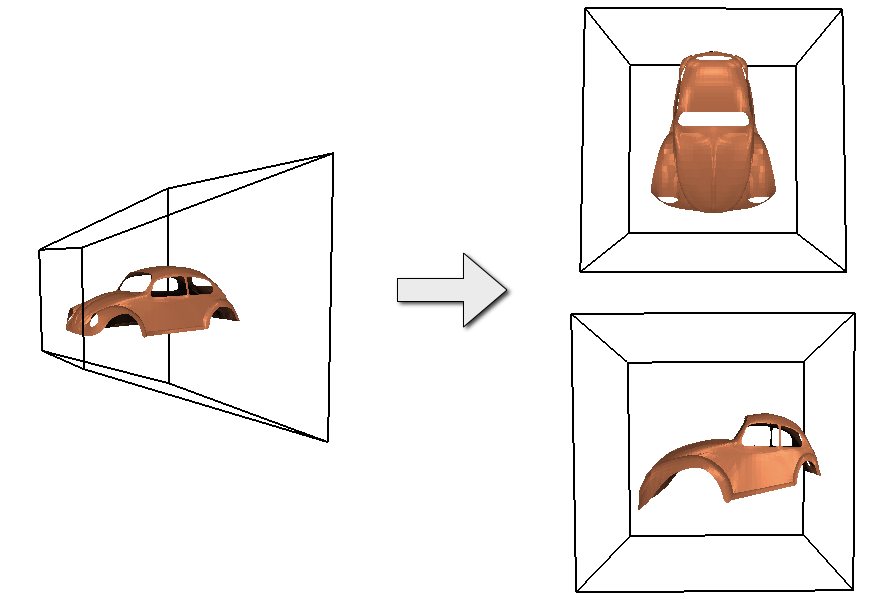
Transformation Pipeline

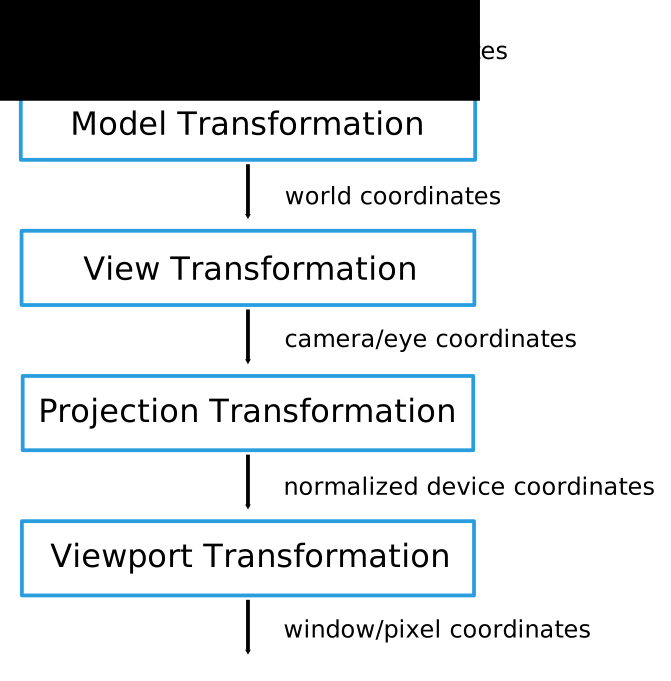
  • View Transformation
    • setup extrinsic camera parameters: position and orientation
  • Projection Transformation
    • setup intrinsic camera parameters: opening angle and depth range
  • Viewport Transformation
    • setup image parameters/resolution: width and height
images/opengl-transformations.svg

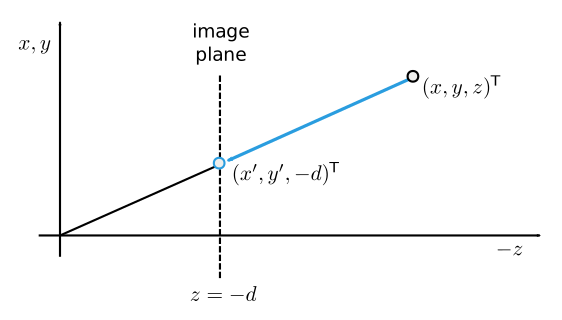
Generic Perspective Projection

  • Standard projection
    • Center of projection: \((0,0,0)\)
    • Image plane at \(z=-d\)
images/perspective-projection.svg

\[ \vector{x\\y\\z} \;\mapsto\; \vector{x \cdot \frac{-d}{z} \\ y \cdot \frac{-d}{z} \\ -d} \quad\longleftrightarrow\quad \matrix{ 1 & 0 & 0 & 0 \\ 0 & 1 & 0 & 0 \\ 0 & 0 & 1 & 0 \\ 0 & 0 & -1/d & 0 } \cdot \vector{x\\y\\z\\1} \;=\; \vector{x\\y\\z\\-z/d} \;\cong\; \vector{x \frac{-d}{z} \\ y \frac{-d}{z} \\ -d\\ 1} \]

Homogeneous Coordinates

  • Use homogeneous coordinates \((x,y,z,w)\)!
    • Vectors are represented by \(\transpose{(x,y,z,0)}\)
    • Points are represented by \(\transpose{(wx,wy,wz,w)}\) for any \(w \neq 0\)
  • Divide a point \(\transpose{(wx,wy,wz,w)}\) by \(w\) to get its canonical representation \(\transpose{(x,y,z,1)}\) (“homogenization”)
    • Defer homogenization until the very last step
  • We can now use \(4 \times 4\) matrices for
    • linear transformations (scaling, rotation)
    • affine transformations (linear map + translation)
    • projective transformations (affine map + projection)

Today: Rasterization Details

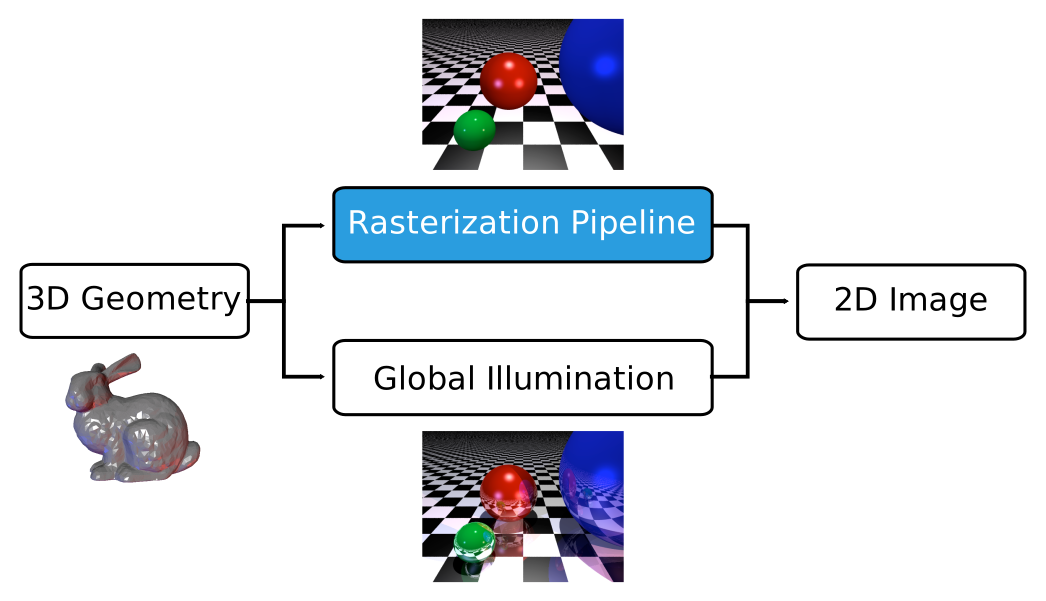
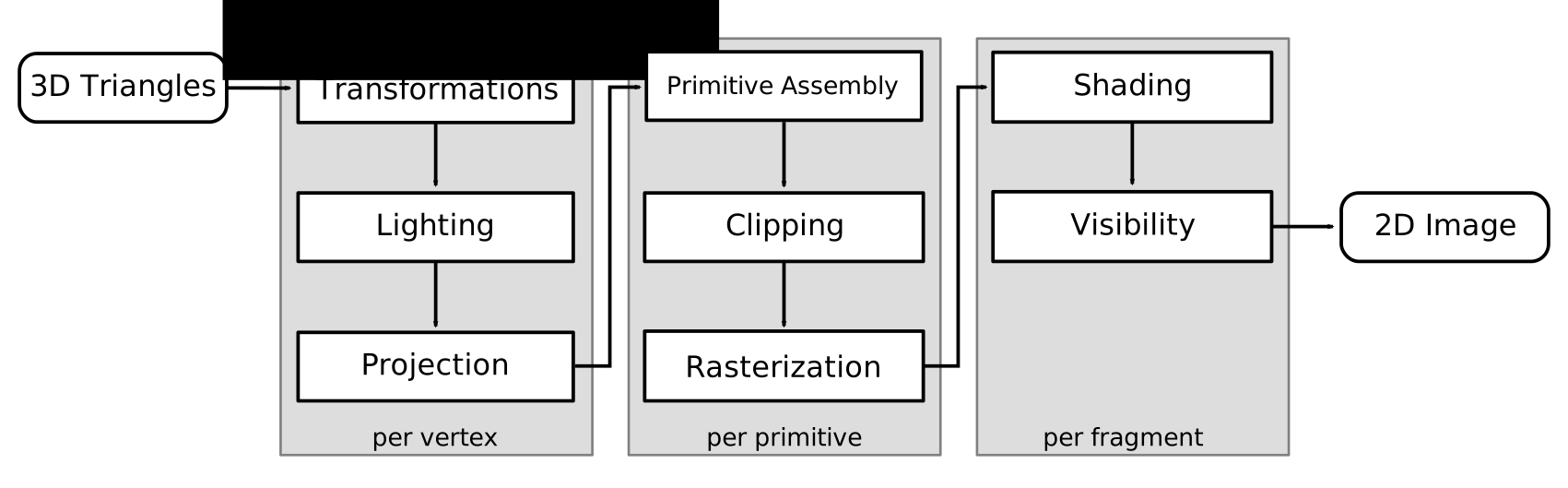
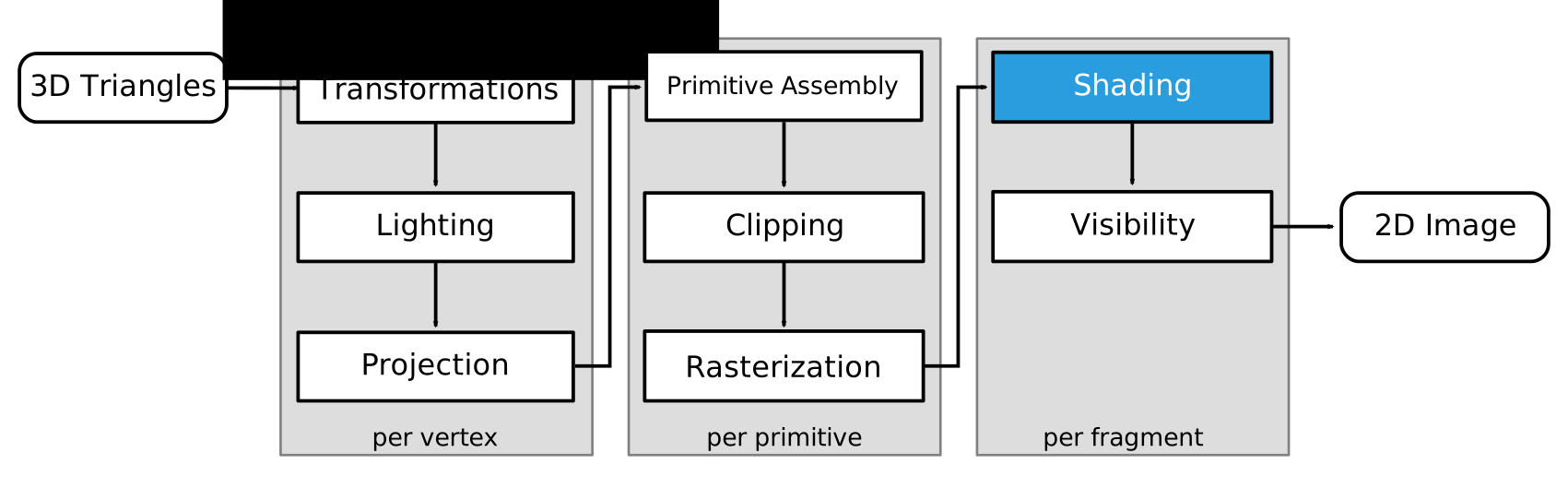
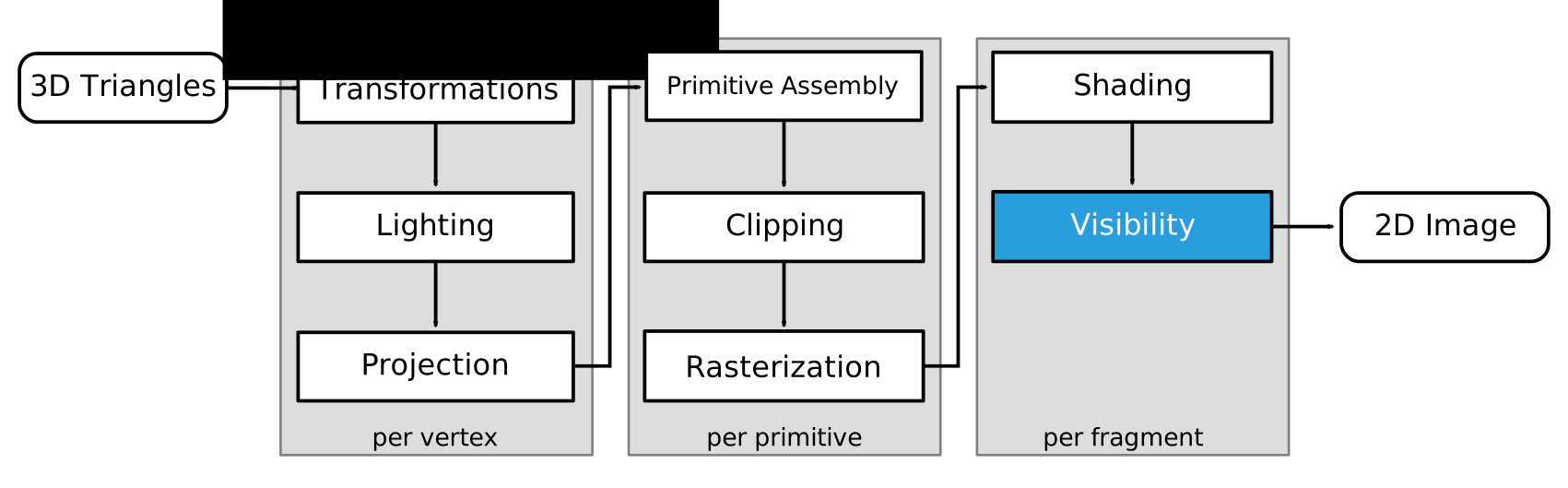
Rasterization Pipeline

images/graphics-rasterization.svg

Ray Tracing vs. Rasterization

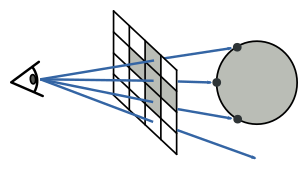
  • Ray Tracing
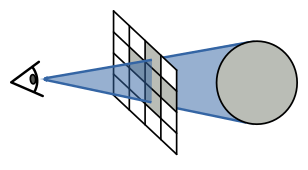
    • Shoot rays from 2D pixels into 3D scene
    • “backward rendering”
    • needs ray intersections
images/raytracing-vs-rasterization-1.svg

  • Rasterization
    • Project 3D objects onto 2D image plane
    • “forward rendering”
    • needs transformations & projections
images/raytracing-vs-rasterization-2.svg

Rasterization Pipeline

images/rendering-pipeline.svg

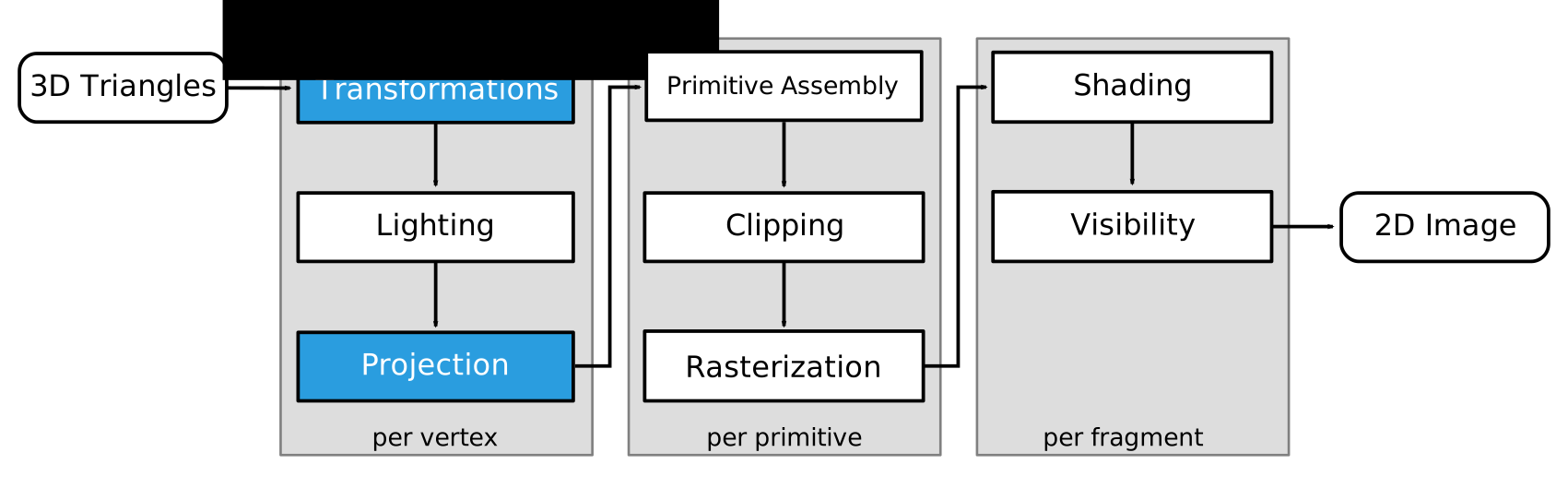
Transformations & Projections

images/rendering-pipeline-1.svg

Transformations & Projections

  • Project line or triangle from 3D to 2D
    • Simply transform/project its endpoints/vertices
    • Why is this correct?
  • Let us first analyze this for a line between \(\vec{A}\) and \(\vec{B}\) \[ \vec{X}\of{\alpha} = (1-\alpha) \vec{A} + \alpha \vec{B} \]
  • For an affine/projective transformation \(\mat{M}\) it has to hold \[ \forall \alpha \in \R \;\; \exists \beta \in \R \;:\; \mat{M}\of{\vec{X}\of{\alpha}} \;=\; (1-\beta)\mat{M}\of{\vec{A}} + \beta \mat{M}\of{\vec{B}} \]

Affine Transformations of Lines

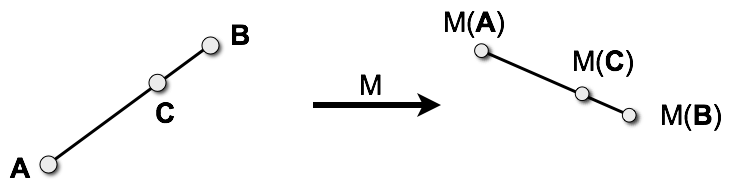
  • Affine transformation \(\mat{M}\) preserves affine combinations \[ \mat{M}\of{(1-\alpha)\vec{A} + \alpha\vec{B}} \;=\; (1-\alpha)\mat{M}\of{\vec{A}} + \alpha\mat{M}\of{\vec{B}} \]
images/trafo-lines.png

Projective Transformations of Lines

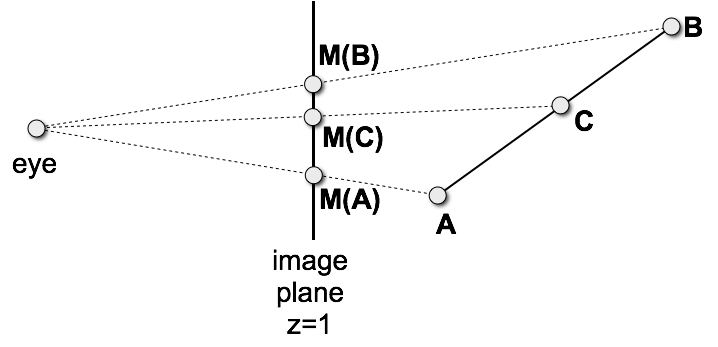
  • For a central projection \(\mat{P}(\vec{X}) = \frac{\vec{X}}{\vec{X}_z}\) we can show that
    \(\mat{P}\of{\vec{X}\of{\alpha}} = \frac{(1-\alpha)\vec{A} + \alpha\vec{B}}{(1-\alpha)\vec{A}_z + \alpha\vec{B}_z} = (1-\beta) \frac{\vec{A}}{\vec{A}_z} + \beta \frac{\vec{B}}{\vec{B}_z}\)
    if we chose \(\beta \;=\; \frac{\alpha\vec{B}_z}{(1-\alpha)\vec{A}_z + \alpha\vec{B}_z}\)
  • Same argument holds for general projective transformations.
images/trafo-lines-2.png

Transformations of Triangles

  • A triangle is an affine combination of three points \[ \vec{X}\of{\alpha, \beta, \gamma} \;=\; \alpha\vec{A} + \beta\vec{B} + \gamma\vec{C}\]

    with \(\alpha+\beta+\gamma=1\).

  • Affine transformation preserve affine combinations

    • Triangles are transformed to triangles
  • Planar projections map triangles to triangles

    • Similar derivation as for lines

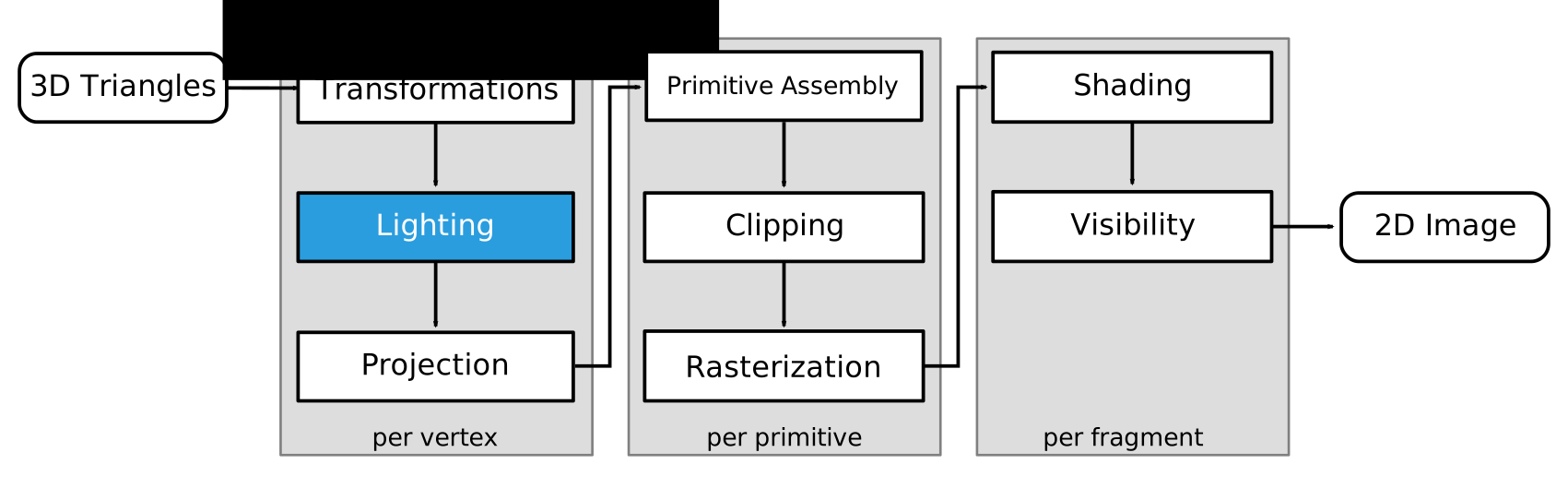
Lighting

images/rendering-pipeline-2.svg

Normal Vectors

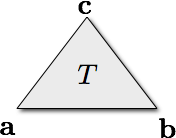
  • Triangle normal \[ \vec{n}(T) = \frac{\left(\vec{b}-\vec{a}\right) \times \left(\vec{c}-\vec{a}\right)} {\norm{\left(\vec{b}-\vec{a}\right) \times\left(\vec{c}-\vec{a}\right)}} \]
images/normal-triangle.png

  • Vertex normal \[ \vec{n}(V) = \frac{ \sum_{T_i \ni V} w(T_i) \, \vec{n}(T_i)} { \norm{ \sum_{T_i \ni V} w(T_i) \, \vec{n}(T_i)} } \]
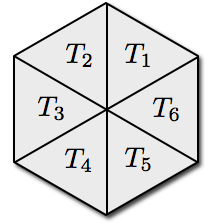
images/normal-vertex.png

Vertex Normals

images/vertex-normals-1.pngtriangulation (flat shading) images/vertex-normals-2.pngno weighting images/vertex-normals-3.pngangle-weighted

Phong Lighting Model

  • Ambient lighting
    • approximate global light transport / exchange
    • uniform in, uniform out
images/spheres-0.png
  • Diffuse lighting
    • dull / matt surfaces
    • directed in, uniform out
images/spheres-1.png
  • Specular lighting
    • shiny surfaces
    • directed in, directed out
images/spheres-2.png

Phong Lighting Model

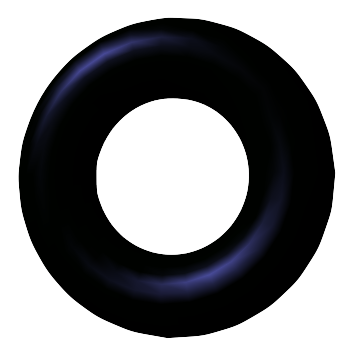
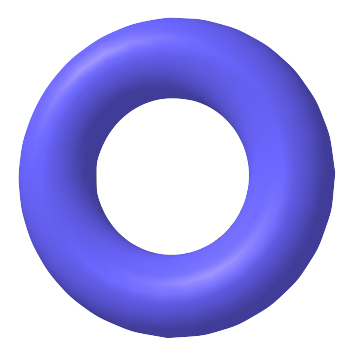
images/torus-a.pngambient: \(I_a m_a\) images/torus-d.pngdiffuse: \(I_l m_d \left( \vec{n} \cdot \vec{l} \right)\) images/torus-s.pngspecular: \(I_l m_s \left( \vec{r} \cdot \vec{v} \right)^s\)
images/torus-ads.png
\[ I \;=\; I_a m_a + I_l \left( m_d \left( \vec{n} \cdot \vec{l} \right) + m_s \left( \vec{r} \cdot \vec{v} \right)^s \right) \]

How to transform normal vectors?
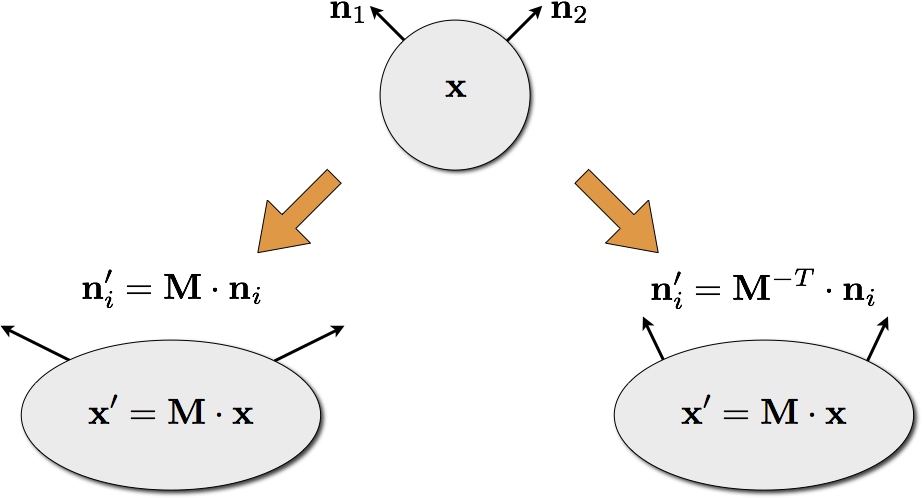
  • A point \(\vec{x} = \transpose{(x,y,z,1)}\) lies on its tangent plane, specified by \(\vec{n} = \transpose{(n_x, n_y, n_z, d)}\): \[ n_x x + n_y y + n_z z + d = 0 \quad\Leftrightarrow\quad \transpose{\vec{n}} \vec{x} = 0 \]
  • The same equation should be satisfied after an affine transformation \(\mat{M}\) maps \(\vec{x}\) to \(\vec{x}'\) and \(\vec{n}\) to \(\vec{n}'\) \[ 0 \;=\; \transpose{\vec{n}'} \vec{x}' \;=\; \transpose{\vec{n}'} \mat{M} \vec{x} \;=\; \transpose{\left(\transpose{\mat{M}} \vec{n}' \right)} \vec{x} \]
  • Comparing the two equations yields \(\vec{n}' = \mat{M}^{\mathsf{-T}} \vec{n}\)
    • In practice use upper-left \(3 \times 3\) block of \(\mat{M}\)
    • Don’t forgot to re-normalize \(\vec{n}'\)

How to transform normal vectors?

images/normal-transformation.png

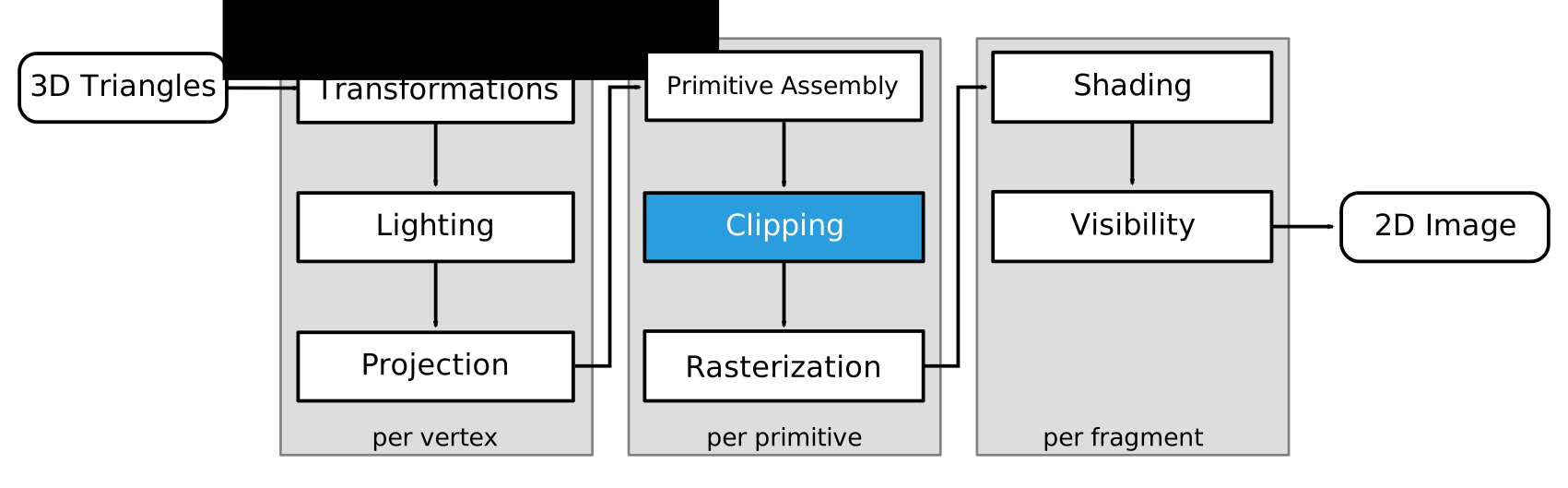
Clipping

images/rendering-pipeline-3.svg

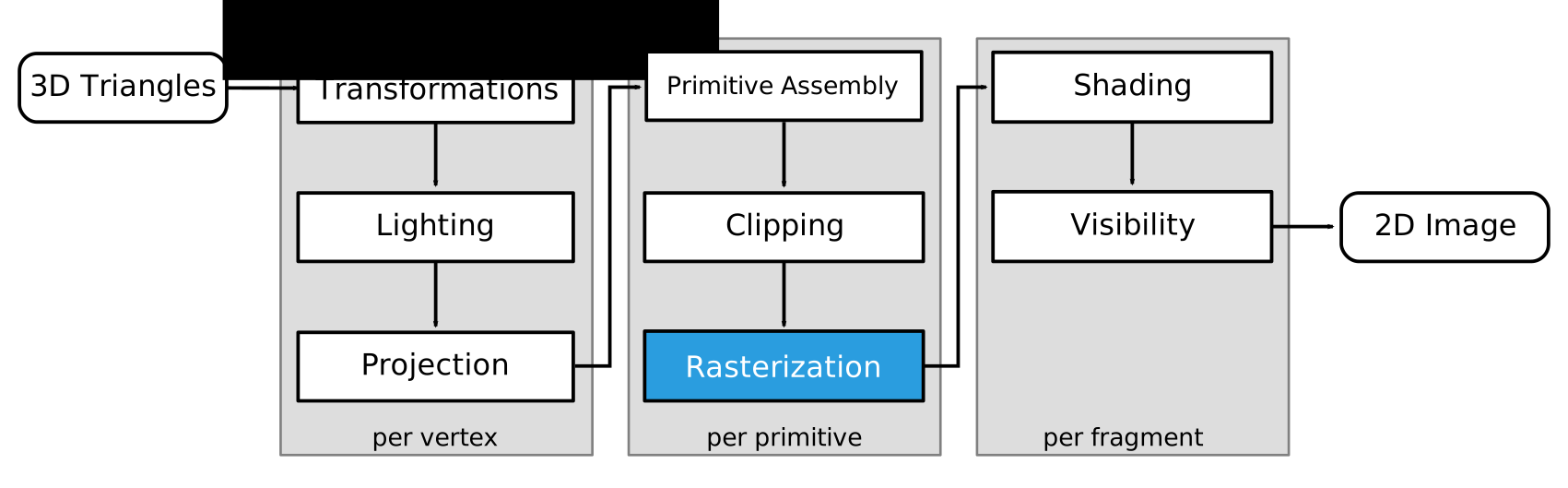
Rasterization

images/rendering-pipeline-4.svg

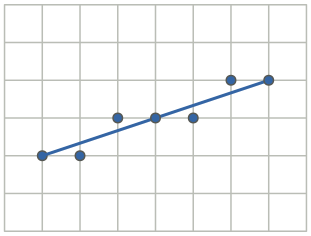
Line Rasterization

  • Discretize line from \((x_0, y_0)\) to \((x_1, y_1)\) to pixel grid.
    • Endpoints are integer coordinates (pixel positions)
    • Assume slope is in \([0,1]\) and \(x_0 < x_1\)
    • Other cases follow by symmetry
images/rasterized-line.svg

How would you implement this?

Line Representation

  • Explicit representation
    • Range of a function \(y(x) = m\,x + t\)
      with \(m = \frac{y_1-y_0}{x_1-x_0}\) and \(t = y_0 - m\,x_0\)

First Guess

for (x=x0; x<=x1; ++x)
	set_pixel(x, round(m*x + t));

  • Bad: Multiplication & Rounding

Digital Differential Analysis

  • Use an incremental algorithm!
  • If the current pixel is \((x_i, y_i)\) then
    • \(x_{i+1} = x_i + 1\)
    • \(y_{i+1} = y_i + m\)
for (x=x0, y=y0; x<=x1; ++x, y+=m)
	set_pixel(x, round(y));

  • Good: no multiplication
  • Bad: rounding, since \(y\) and \(m\) are floats

Line Representations

  • Explicit representation
    • Range of a fuction \(y(x) = m\,x + t\)
      with \(m = \frac{y_1-y_0}{x_1-x_0}\) and \(t = y_0 - m\,x_0\)
  • Implicit representation
    • Zero-set of a function \(F(x,y) = ax + by + c\)
      with \(a = (y_1-y_0)\), \(b = (x_0-x_1)\), \(c = t \, (x_1-x_0)\)
    • \(F(x,y) = 0\) \(\Longrightarrow\) point on line
    • \(F(x,y) > 0\) \(\Longrightarrow\) point below line
    • \(F(x,y) < 0\) \(\Longrightarrow\) point above line

Bresenham Algorithm

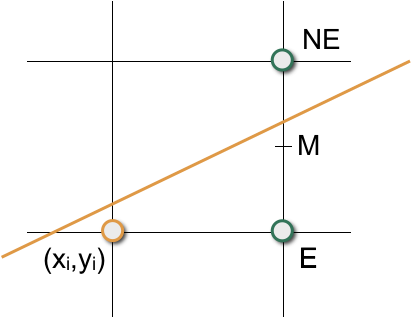
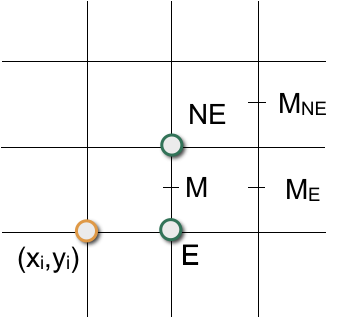
  • Next pixel can only be east (E) or north-east (NE)
    • Is the line below/above midpoint \(\vec{M}\)?
  • Use a decision variable \(d\):
    • \(d = F(M) = F(x_i+1, y_i+0.5)\)
    • If \(d \leq 0\) then go east
    • If \(d > 0\) then go north-east
images/bresenham-1.png

Bresenham Algorithm

  • Incrementally update decision variable \(d\)!
  • If east was chosen:
    • \(d_\mathrm{new} = F(x_i+2, y_i+0.5) = d_\mathrm{old} + a\)
    • \(\Delta\mathrm{E} := a = \Delta y\)
  • If north-east was chosen:
    • \(d_\mathrm{new} = F(x_i+2, y_i+1.5) = d_\mathrm{old} + a + b\)
    • \(\Delta\mathrm{NE} := a + b = \Delta y - \Delta x\)
images/bresenham-2.png

Bresenham Algorithm

  • Initialization of \(d\)
    • \(d = F(x_0+1, y_0+0.5) = \Delta y - \Delta x / 2\)
    • Bad: \(\Delta x / 2\) may not be integer
  • Use \(2 \cdot F(x,y)\) instead of \(F(x,y)\)
    • Values of \(d\), \(\Delta\mathrm{E}\), \(\Delta\mathrm{NE}\) are doubled
    • But sign of \(F\) and \(d\) remain unchanged

Bresenham Algorithm

Δx  = x1-x0;
Δy  = y1-y0;
d   = 2*Δy - Δx;
ΔE  = 2*Δy;
ΔNE = 2*(Δy - Δx);

set_pixel(x0, y0);

for (x = x0, y = y0; x < x1;)
{
	if (d <= 0)    { d += ΔE;  ++x;     }
	else           { d += ΔNE; ++x; ++y }
	set_pixel(x, y);
}

Good: Only integer arithmetic!

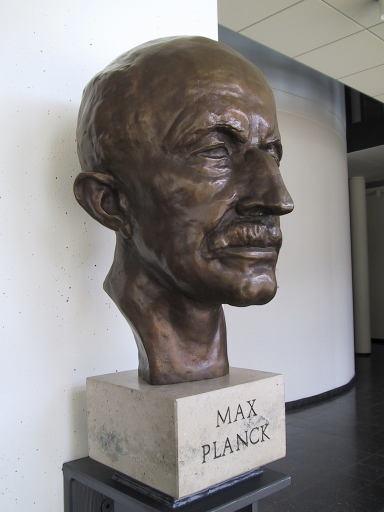
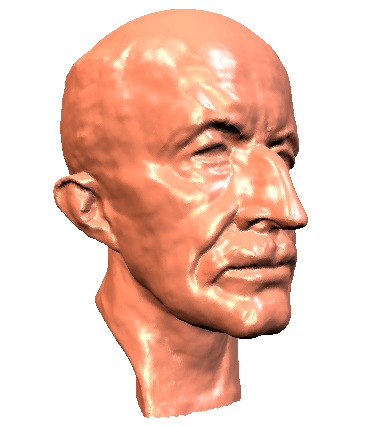
Why only integer arithmetic?

images/max-0.png images/max-3.png images/max-4.png

Crucial for systems without FPU

Triangle Rasterization

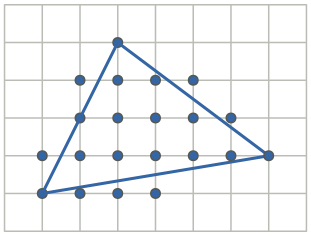
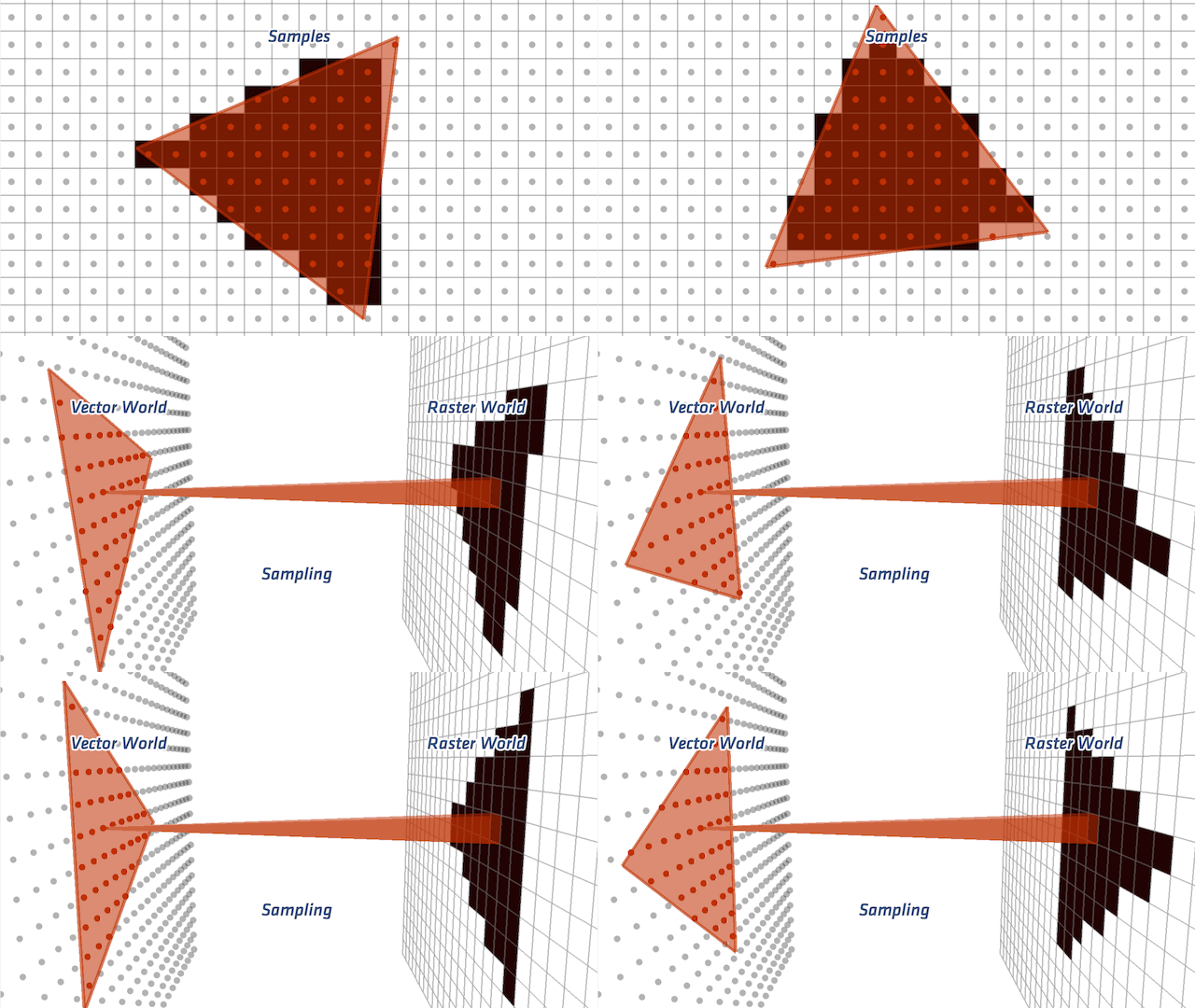
  • Enumerate all pixels inside a 2D triangle
    • Inside test for every pixel is too expensive
  • Compute horizontal spans in each scanline
    • Compute intersections with triangle edge, fill inbetween
images/rasterized-triangle.svg
  • Many special cases to consider!

Triangle Rasterization
images/rasterization.gif

Shading

images/rendering-pipeline-5.svg

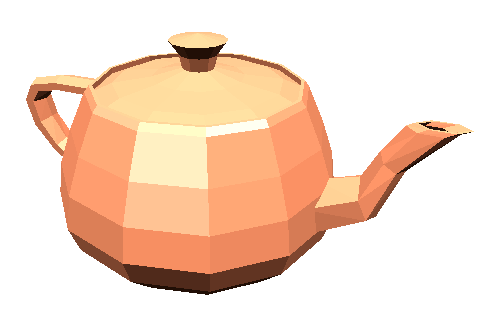
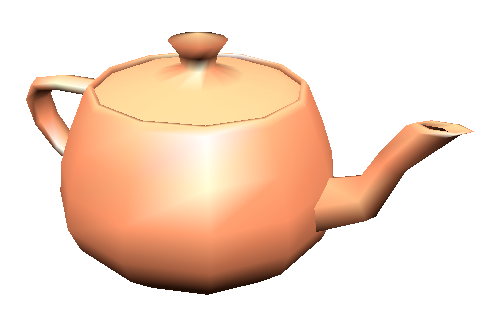
Shading: Fill the Interior

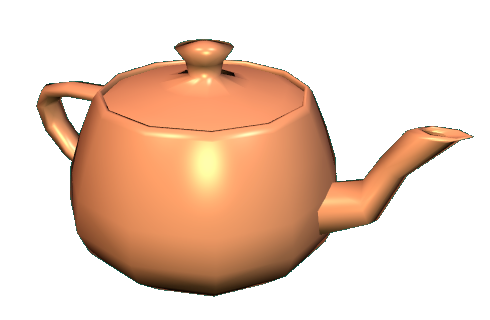
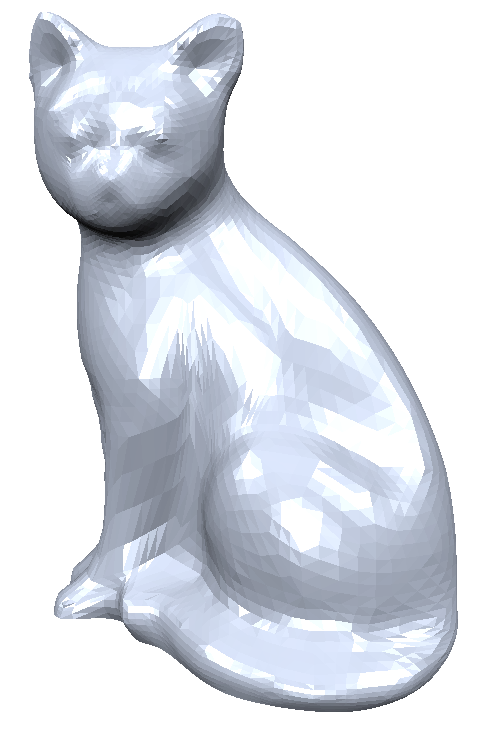
  • Flat Shading
    • Compute Phong lighting per face
    • Facetted appearance
    • Mach band effect
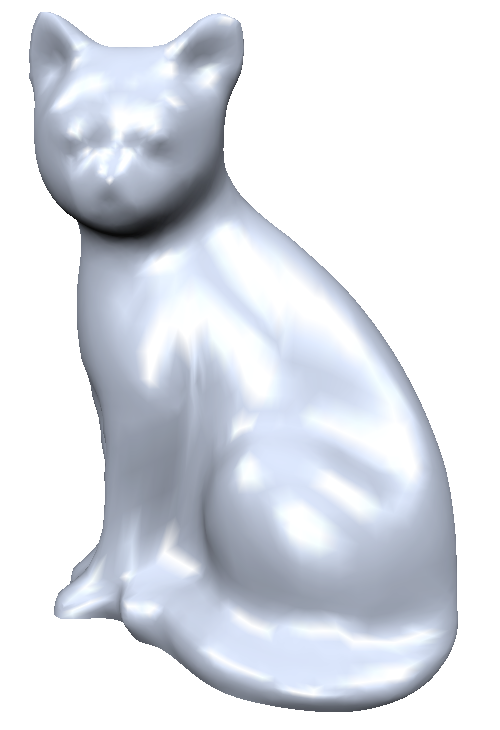
  • Gouraud Shading
    • Compute Phong lighting per vertex
    • Linear interpolation of colors
    • Looses small highlights
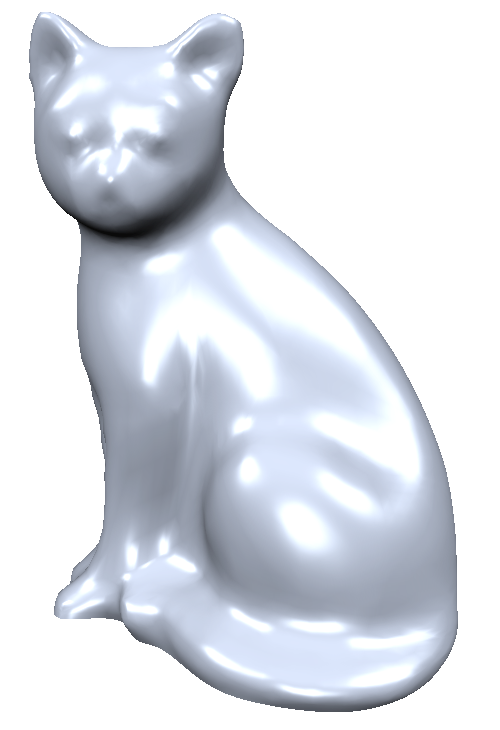
  • Phong Shading
    • Linear interpolation of vertex normals
    • Compute Phong lighting per pixel
    • Captures small highlights

images/teapot-flat.png
images/teapot-gouraud.png
images/teapot-phong.png

Shading: Fill the Interior

images/cat-flat.pngFlat Shading images/cat-gouraud.pngGouraud Shading images/cat-phong.pngPhong Shading

Shading: Fill the Interior

Visibility

images/rendering-pipeline-6.svg

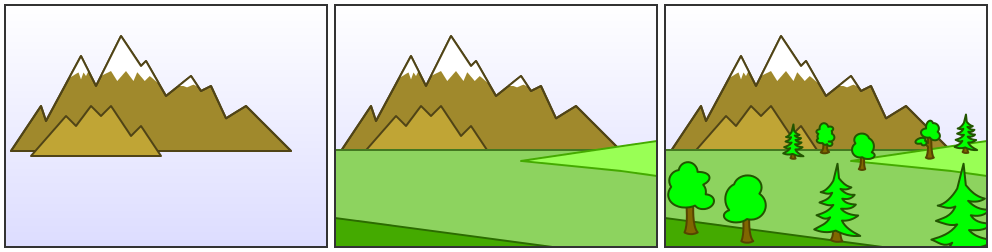
Painter’s Algorithm

  • Idea: How do painters paint?
    • Draw objects/triangles from back to front
    • Overwrites polygons in the back

Painter’s Algorithm

  • Idea: How do painters paint?
    • Draw objects/triangles from back to front
    • Overwrites polygons in the back
  • Algorithm
    • Sort all polygons w.r.t. \(z_\text{max}\) (farthest vertex)
    • Disambiguate if \(z\)-ranges of polygons overlap
    • Paint polygons from back to front
    • Complexity: \(O(n \log n)\) for \(n\) polygons

Painter’s Algorithm

  • Disambiguate if \(z_\text{max}(A) > z_\text{max}(B) > z_\text{min}(A)\)
    • Paint \(A\) if
      • \([x,y]\)-ranges not overlapping, or
      • Non-overlapping projections
      • \(A\) behind supporting plane of \(B\), or
      • \(B\) in front supporting plane of \(A\), or
    • Swap \(A\) & \(B\)
      • \(B\) behind supporting plane of \(A\), or
      • \(A\) in front supporting plane of \(B\)

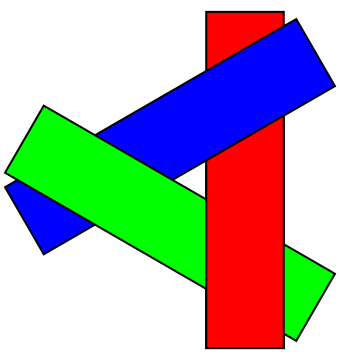
Painter’s Algorithm

  • Repeated swap → cyclic overlap
    • Split \(A\) at supporting plane of \(B\) or vice versa
images/340px-Painters_problem.svg.png

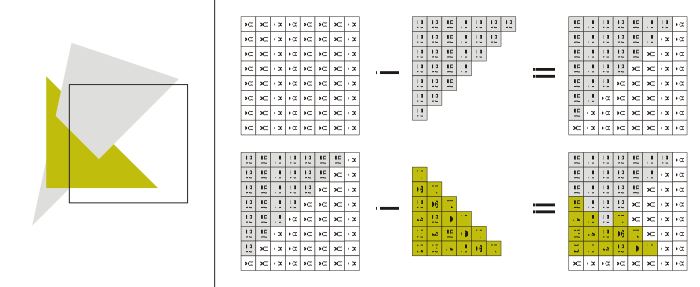
Z-Buffer

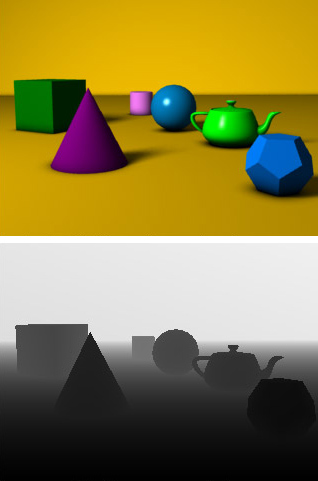
  • Store current min. z-value for each pixel
    • After model transformation, view transformation, projection transformation, and viewport transformation
  • Additional buffer for depth values
    • Framebuffer stores RBG color values
    • Depth buffer (z-buffer) stores depth values
    • Storage: additional 16 to 32 bits per pixel
images/z-buffer.jpg
Wikipedia

Z-Buffer

  • Initialize depth buffer to \(\infty\)

  • Rasterize triangles, interpolate depth value per fragment

    • each fragment (x,y) still has a depth value z
  • Depth buffer test & update

    // draw color rgb to pixel (x,y)
    void set_pixel(x, y, z, rgb)
    {
        // is current pixel closer than stored z-value?
        if (z < zbuffer[x,y])
        {
            // write pixel's color to frame buffer
            framebuffer[x,y] = rgb;

            // update depth buffer
            zbuffer[x,y] = z;
        }
    }

Z-Buffer

images/z-buffer.svg
Image from Wikipedia

Z-Buffer

  • Complexity
    • \(O(n)\) for \(n\) polygons
    • How can we sort n polygons in linear time?
  • Most important visibility algorithm
    • Implemented in hardware for all GPUs
    • Used by OpenGL

Quiz: z-Buffer

How will the z-buffer resolve visibility when two triangles \(A\) and \(B\) lie in the same plane and overlap? Assume triangle \(A\) is drawn before triangle \(B\).

  • \(A\) will be completely visible.
  • \(B\) will be completely visible.
  • Some pixels from \(A\) and some pixels from \(B\) will be visible in the overlap region.
  • One triangle is completely visible, but it is random which one.

Z-Buffer

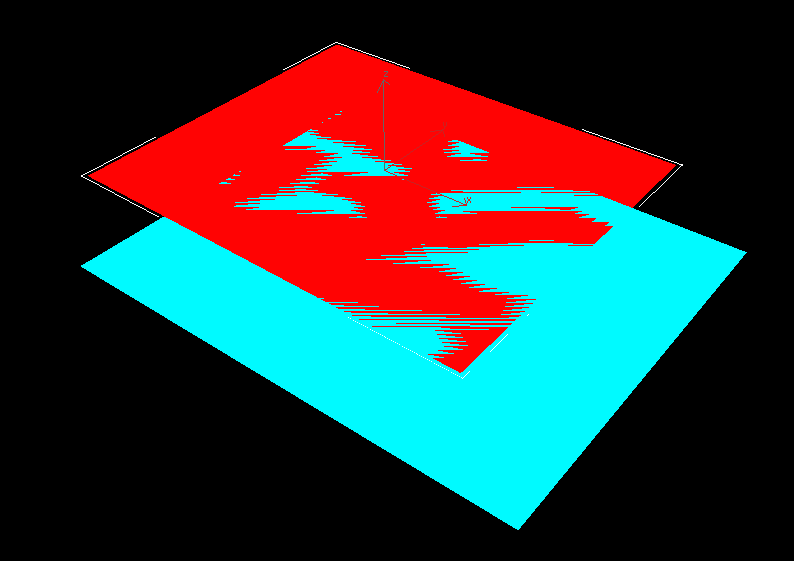
  • Z-fighting
images/Z-fighting.png

Wikipedia

Quiz: z-Buffer

How does quantization of the z-values affect visibility inside the view volume?

  • z-testing has the same effective resolution in the entire view volume.
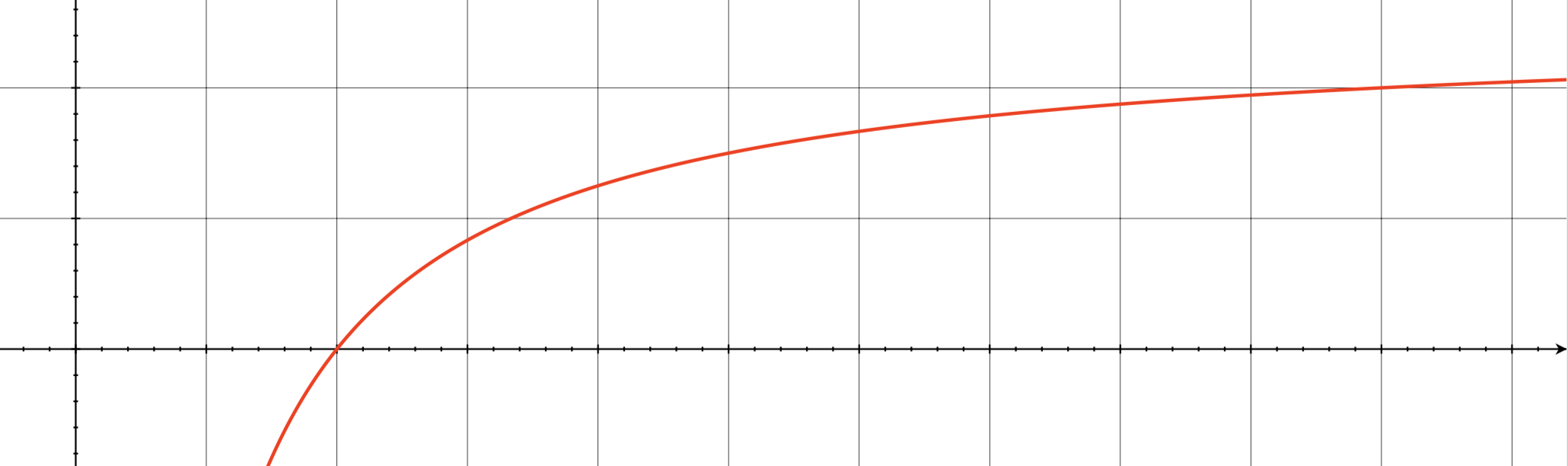
  • z-testing has more effective resolution close to the near plane.
  • z-testing has more effective resolution far from the near plane.

Z-Buffer

  • Higher resolution at near plane!
images/frustum-4.png

Rasterization Pipeline

images/rendering-pipeline.svg

Ray Tracing vs. Rasterization

“Rasterization is fast, but needs cleverness to support complex visual effects. Ray tracing supports complex visual effects, but needs cleverness to be fast.”

– David Luebke, Nvidia

Literature

  • Hughes et al.: Computer Graphics: Principles and Practice, 3rd Edition, Addison-Wesley, 2014.
    • Chapter 15
images/cgpp.png